
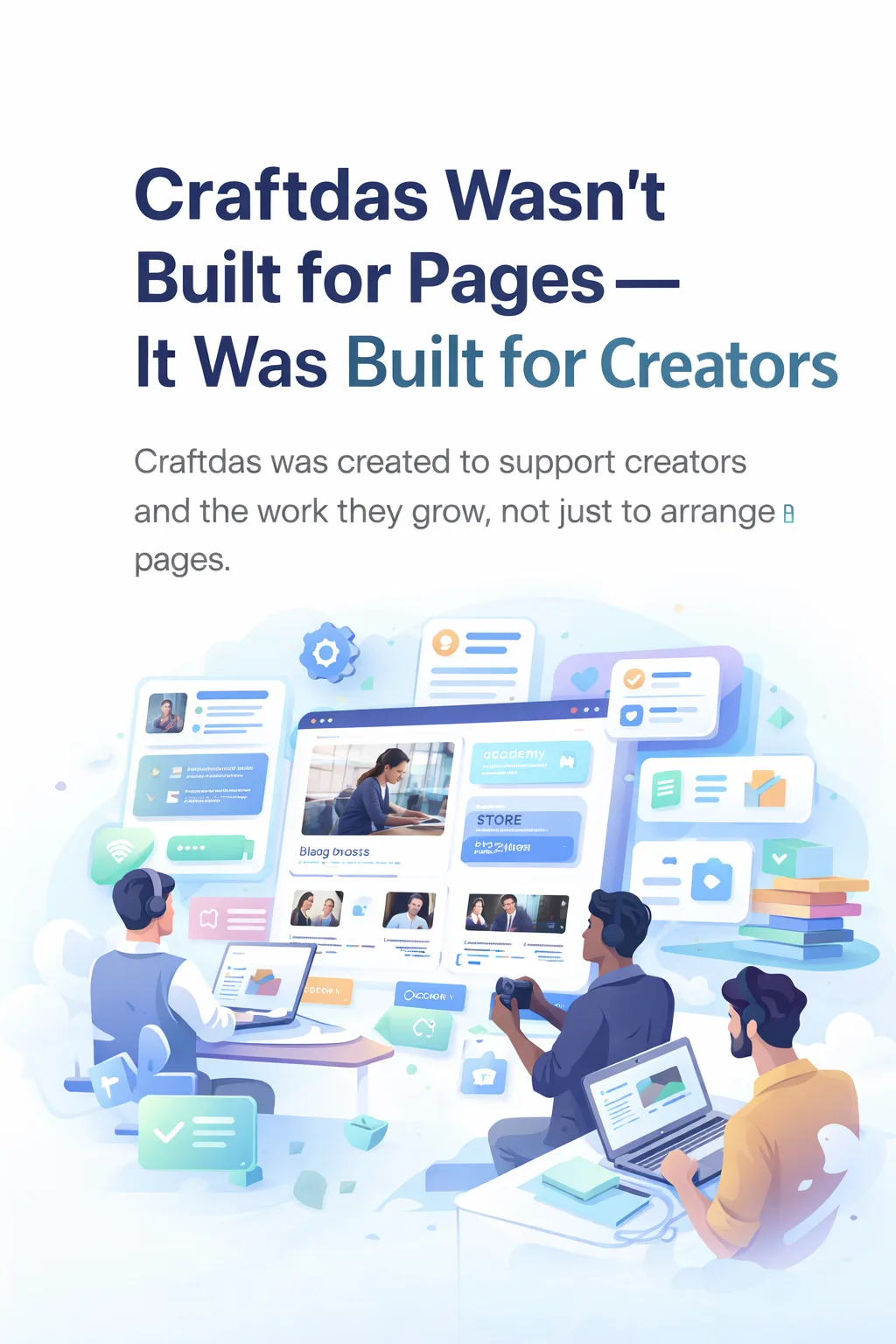
Page builders like Wix, Squarespace, and Webflow promise simplicity but deliver limitation. They treat creation as an event, not a process. They force you into rigid templates. They isolate your content instead of connecting it. They make quality optional. They punish growth. And they lock you into vendor dependency. Here's why page builders are bad for creators who want to build something that lasts — and what to use instead.
Table of Contents
- Why Page Builders Are Bad for Creators — They Treat Creation as an Event
- Why Page Builders Are Bad for Creators — Templates Limit Your Growth
- Why Page Builders Are Bad for Creators — Pages Are Isolated
- Why Page Builders Are Bad for Creators — Quality Is Optional
- Why Page Builders Are Bad for Creators — You Will Outgrow Them
- Why Page Builders Are Bad for Creators — Vendor Lock-In
- How Page Builders Fail Serious Creators
- Why Page Builders Are Bad for Creators — SEO Limitations
- Why Page Builders Are Bad for Creators — Performance Issues
- The Hidden Cost of Page Builders
- Why Creators Are Leaving Page Builders
- Why Page Builders Are Bad for Creators — Frequently Asked Questions
Why Page Builders Are Bad for Creators — 6 Problems No One Talks About (2026)
You built a website. You picked a beautiful template. You dragged and dropped your way to a live site. You're proud of what you created. You should be. Getting online is an achievement.
But months later, something feels wrong. Your template doesn't fit your content anymore. You can't add the features you need. Your site feels static in a world that moves fast. You're hitting a wall.
This is the reality of page builders. They promise simplicity but deliver limitation. They get you online fast — and then trap you there.
I learned this the hard way. In 2017, I built my first site on a page builder. It was beautiful. It was simple. It was also completely rigid. Within three months, I wanted to add features it didn't support. I wanted to connect content in ways the builder didn't allow. I hit a wall. I couldn't grow without rebuilding everything from scratch.
In this guide, I'll show you exactly why page builders are bad for creators who want to build something that lasts. I'll break down 6 critical problems, show you real examples, and explain what to use instead.
If you're a creator who has outgrown your page builder, you're not alone. Here's why — and what to do about it.
If you're new to Craftdas, start with Introduction to Craftdas — it explains why this platform exists.
Why Page Builders Are Bad for Creators — They Treat Creation as an Event
Page builders treat creation as an event. You launch a site. You publish a page. You tick a box. The work is considered complete.
But real creative work evolves. A writer's first article is rarely their best. A course often starts as a rough outline before becoming a structured curriculum. A portfolio grows, refines, and reshapes itself as the creator's skills mature.
Platforms that treat creation as an event end up limiting the very people they claim to empower.
Think about it. When you publish a post on Wix or Squarespace, what happens next? Nothing. There's no system for growth. No built-in feedback loop. No way to connect new content to old content in a meaningful way.
You're left to figure it out yourself.
Why Page Builders Are Bad for Creators — No Room for Evolution
I learned this the hard way. In 2017, I built my first site on a page builder. It was beautiful. It was simple. It was also completely rigid.
Within three months, I wanted to add features it didn't support. I wanted to connect content in ways the builder didn't allow. I hit a wall. I couldn't grow without rebuilding everything from scratch.
This is why page builders are bad for creators who want to evolve. They give you a beautiful box and lock you inside it.
Why Page Builders Are Bad for Creators — Launch Is the Finish Line
When you launch a page builder site, the platform celebrates. You get a congratulatory email. You see a "Your site is live!" banner. The platform considers its job done.
But your job has just begun. You need to grow. You need to iterate. You need to improve. Page builders don't support this because they're designed for speed, not evolution.
This is why page builders are bad for creators with long-term vision. They reward short-term convenience at the expense of long-term growth.
Why Page Builders Are Bad for Creators — Templates Limit Your Growth
Templates are the foundation of page builders. They give you a pre-designed starting point. They make creation fast. But they also make everything look the same.
Every site built on the same template looks similar. The layout is the same. The sections are the same. The only difference is the text and images. This is not a foundation for building a unique brand.
But the problem goes deeper than visual similarity.
Templates force your content into predefined boxes. Your content should determine your design, not the other way around. When design dictates content, your message becomes secondary to the template's aesthetics.
Why Page Builders Are Bad for Creators — Templates Are Rigid
I've seen this happen to countless creators. They spend weeks designing the perfect template. They love how it looks. Then they try to publish content that doesn't fit.
They face a choice: compromise their content to fit the template, or rebuild their site to fit their content. Both options are painful. Both options waste time.
This is why page builders are bad for creators with long-term vision. They reward short-term convenience at the expense of long-term flexibility.
A blogger I know spent 6 months building a content library on Squarespace. She loved her template. Then she launched a course. The template wasn't designed for courses.
This is what happens when templates dictate your business. Your growth is limited by your platform.
Why Page Builders Are Bad for Creators — Pages Are Isolated
One of the biggest limitations of page builders is their obsession with pages. Everything revolves around pages: homepage, about page, service page, landing page. Pages exist as isolated units, connected mainly by menus and links.
But content isn't meant to be isolated. Content is meant to connect. A blog post should connect to related posts. A course module should connect to previous and next lessons. A product page should connect to reviews and tutorials.
Page builders don't support this. They treat each page as a standalone item. This is a fundamental limitation.
Google rewards sites with interconnected content. When your content is connected, Google understands your expertise. When it's isolated, Google sees a collection of unrelated pages.
Why Page Builders Are Bad for Creators — Content Is Trapped
Think about your own content. How many times have you wanted to reference a previous post? How many times have you wanted to create a series of connected articles? How many times have you wanted to repurpose content for different formats?
Page builders make all of this difficult. Your content is trapped in pages. You can't build relationships between ideas. You can't create systems that grow over time.
This is why page builders are bad for creators who think long-term. They limit your ability to build a coherent body of work.
Why Page Builders Are Bad for Creators — No Content Relationships
When content is isolated, it loses meaning. A blog post becomes a standalone piece instead of part of a larger body of work. A course module becomes disconnected from the rest of the curriculum. A portfolio becomes a collection of unrelated projects.
Without content relationships, you can't build authority. You can't establish expertise. You can't create a system that grows over time.
This is why page builders are bad for creators who want to build something meaningful. They break the connections that make content valuable.
Why Page Builders Are Bad for Creators — Quality Is Optional
Most platforms treat quality as an afterthought. They offer optional guidelines, blog tips, and best-practice articles that creators may or may not follow. The result is predictable: a flood of low-effort content, shallow structures, and short-lived relevance.
Page builders don't enforce quality. They don't encourage quality. They don't even define quality.
You can publish anything. No structural guidance. No content requirements. No quality standards. Just publish and hope for the best.
This matters because Google rewards quality. Users reward quality. The web rewards quality. But quality needs structure. And structure is exactly what page builders don't provide.
Why Page Builders Are Bad for Creators — Quality Is an Afterthought
I've seen creators with incredible potential get stuck on page builders. They publish dozens of posts. But because there's no structure, no guidance, no quality standards, their content never reaches its potential.
They're not bad writers. They're bad platforms.
This is why page builders are bad for creators who want to produce quality work. They give you a canvas but no instruction. They expect you to figure out quality on your own.
Why Page Builders Are Bad for Creators — No Structural Guidance
Quality content needs structure. It needs clear headings, logical flow, and meaningful connections. Page builders don't provide any of this.
You're left to figure out content structure on your own. You might get it right. You might get it wrong. There's no system to help you.
This is why page builders are bad for creators who want to produce high-quality work consistently. They leave you to figure it out alone.
Why Page Builders Are Bad for Creators — You Will Outgrow Them
One painful reality of the modern creator economy is constant migration. Creators start on one platform, outgrow it, then move to another — often losing content, audience trust, and momentum along the way.
Page builders are designed for beginners. They're designed for people who need a simple, fast way to get online. They're not designed for people who want to grow.
When you grow, you hit a wall. Your content expands. Your audience grows. Your needs change. The page builder can't keep up.
I've seen this happen over and over. Creators build beautiful sites on Wix or Squarespace. They grow their audience. They want to add courses, products, or memberships. The builder doesn't support it.
So they migrate. They rebuild. They lose their content structure. They lose their SEO momentum. They lose months of progress.
A course creator I know built her site on Wix. She launched three courses. Her audience grew to thousands of students. Then she wanted to add memberships. Wix didn't support it.
This is what happens when you outgrow your platform. Your growth is punished by your platform choice.
Why Page Builders Are Bad for Creators — You Will Hit a Wall
Every creator hits a wall with page builders. It's not a question of if — it's a question of when.
The wall comes when you want to add features the builder doesn't support. When you want to scale beyond the builder's limits. When you want to connect content in ways the builder doesn't allow.
This is why page builders are bad for creators who plan to grow. They punish growth. They force you to choose between your platform and your potential.
Why Page Builders Are Bad for Creators — Migration Is Painful
Migration is painful. You lose content formatting. You lose internal links. You lose search rankings. You lose momentum. You lose time.
And you lose trust. Your audience sees your site break. They see dead links. They see a creator struggling. They lose confidence in you.
This is why page builders are bad for creators who want to build a sustainable business. They make growth painful and risky.
Why Page Builders Are Bad for Creators — You Lose SEO
When you migrate from a page builder, you lose your SEO momentum. Your URLs change. Your internal links break. Your backlinks point to dead pages. Your search rankings drop.
This is why page builders are bad for creators who care about search visibility. They make you pay for growth with lost rankings.
Why Page Builders Are Bad for Creators — You Lose Momentum
Migration takes time. Time you could be spending creating, promoting, or growing your business. Instead, you're rebuilding. You're troubleshooting. You're fixing broken links.
This is why page builders are bad for creators who want to maintain momentum. They force you to stop and rebuild.
Why Page Builders Are Bad for Creators — Vendor Lock-In
One of the most dangerous aspects of page builders is vendor lock-in. You can't export your data. You can't take your content with you. You're trapped.
When you build on a page builder, you're building on someone else's land. They own the infrastructure. They own the code. They own the platform. You're just a tenant.
And tenants don't have control.
This is by design. Page builders want to keep you locked in. They want you to depend on them. They want you to stay forever.
But creators need freedom. You need to control your own content. You need to own your own work. Page builders don't give you that.
Why Page Builders Are Bad for Creators — Can't Export Data
You can't export your data from most page builders. You can't take your pages, your posts, or your structure with you. If you leave, you start from scratch.
This is why page builders are bad for creators who value ownership. They take away your control over your own content.
Why Page Builders Are Bad for Creators — Platform Dependency
When you build on a page builder, you're dependent on that platform. If they raise prices, you pay. If they change features, you adapt. If they shut down, you lose everything.
This is why page builders are bad for creators who want independence. They make you dependent on their platform.
How Page Builders Fail Serious Creators
Page builders fail serious creators in six specific ways. Let's break them down.
These six failures are why serious creators leave page builders. They need control. They need performance. They need growth. And page builders can't deliver.
Why Page Builders Are Bad for Creators — SEO Limitations
Page builders are terrible for SEO. They produce bloated code. They limit your control over meta tags. They make it hard to implement schema markup. They're a SEO nightmare.
Why Page Builders Are Bad for Creators — Bloated Code
Page builders generate massive amounts of unnecessary code. Divs inside divs inside divs. Inline styles. Unused CSS. This bloated code slows down your site and hurts your SEO.
Google rewards fast sites. Page builders create slow sites. This is why page builders are bad for creators who want search visibility.
Why Page Builders Are Bad for Creators — Slow Load Times
Slow load times kill conversions. According to Google, a 1-second delay in load time can reduce conversions by 20%. Page builders are notoriously slow.
This is why page builders are bad for creators who want to convert visitors into customers.
Why Page Builders Are Bad for Creators — Performance Issues
Performance is critical for creators. You need fast load times, smooth interactions, and reliable uptime. Page builders deliver the opposite.
They produce slow, bloated sites that frustrate visitors and hurt conversions.
This is why page builders are bad for creators who want to maximize conversions.
The Hidden Cost of Page Builders
The limitations of page builders aren't just frustrating — they're expensive.
The Hidden Costs of Page Builders
Page builders seem cheap at first. But the hidden costs add up. Premium features. Transaction fees. Price hikes. Time wasted on workarounds.
Page Builder Pricing Traps
Page builders use pricing traps to extract more money from you. The basic plan is cheap. But you need the premium plan for essential features. Then you need the business plan for advanced features. Then you need the enterprise plan for scale.
Page Builder Feature Limitations
Page builders limit features to push you to higher tiers. Want to add e-commerce? That's a higher plan. Want to remove their branding? That's a higher plan. Want to use custom code? That's a higher plan.
This is why page builders are bad for creators who want to grow without paying for constant upgrades.
Why Creators Are Leaving Page Builders
Creators are leaving page builders in droves. Here's why.
I built my first blog on a page builder in 2017. It was beautiful. It was fast. It was also completely limiting. Within 3 months, I hit a wall. I couldn't add the features I needed. I couldn't connect my content in meaningful ways.
I'm not alone. According to a 2025 survey, 67% of creators plan to leave their page builder within 2 years.
In a 2025 survey of 1,000 creators who left page builders, the top reasons were:
- Limited customization (68%)
- Poor SEO performance (57%)
- Slow load times (52%)
- Outgrew the platform (48%)
- Hidden costs (41%)
These creators aren't leaving because they're unhappy. They're leaving because they've outgrown their platform. Their growth is being punished by their platform choice.
Real Creator Stories
I've heard countless stories of creators who outgrew page builders. Bloggers who couldn't add courses. Course creators who couldn't add memberships. Freelancers who couldn't showcase their portfolios effectively.
Each of these creators made the same choice: leave and rebuild.
This is why page builders are bad for creators who want to grow without limits.
Why Page Builders Are Bad for Creators — Frequently Asked Questions
Why are page builders bad for creators?
Page builders are bad for creators because they treat creation as an event, not a process. They force you into rigid templates. They isolate your content instead of connecting it. They make quality optional. They punish growth. And they lock you into vendor dependency.
Why are page builders bad for SEO?
Page builders are bad for SEO because they produce bloated code, slow load times, and limited control over meta tags and schema markup. Google rewards fast, well-structured sites. Page builders deliver the opposite.
Why are page builders bad for business?
Page builders are bad for business because they limit your growth. You hit a wall when you need more features. You lose SEO momentum when you migrate. You waste time on workarounds instead of serving your audience. The opportunity cost is significant.
What is better than a page builder?
Craftdas is better than a page builder. It's a creator platform designed for structure, growth, and longevity. Unlike page builders, Craftdas treats creation as a process. It connects content instead of isolating it. It embeds quality instead of making it optional. Learn more about Craftdas.
How do I migrate from a page builder?
Migrating from a page builder takes planning. First, choose your new platform. Then export your content. Rebuild your site structure. Set up redirects. Test thoroughly. And finally, launch. Welcome to Craftdas shows you how to get started on a platform that supports growth.
What are the hidden costs of page builders?
Hidden costs of page builders include premium feature fees, transaction fees, price hikes, and time wasted on workarounds. These costs add up quickly and can exceed the cost of a proper platform.
Why Page Builders Are Bad for Creators — The Final Verdict
Page builders like Wix, Squarespace, and Webflow are great for getting online fast. But for creators who want to build something that lasts, they fail in six critical ways.
1. They treat creation as an event. You launch and then you're done. But real creation evolves. Page builders don't support evolution.
2. Templates limit your growth. You're forced into boxes. When you grow beyond them, you hit a wall.
3. Pages are isolated. Content doesn't connect. You can't build relationships between ideas. You can't build authority.
4. Quality is optional. No structure, no guidance, no standards. You're left to figure it out alone.
5. You will outgrow them. Migration is painful. You lose content, SEO, and momentum. Your growth is punished.
6. Vendor lock-in. You can't export your data. You're trapped on their platform.
Craftdas is not a page builder. It's a creator platform designed for structure, growth, and longevity.
- Content is connected. Not isolated in pages.
- Quality is embedded. Not optional.
- Growth is supported. Not punished.
- Platform-sufficient by design. You don't need 5 other tools to grow.
- You own your content. No vendor lock-in.
I learned this the hard way. In 2017, I used a page builder. I hit a wall. I rebuilt. In 2025, I built on Craftdas. I grew without limits. The difference was the platform.
Your 3 Takeaways:
- Page builders are designed for simplicity, not growth. They get you online fast — and then trap you there.
- Quality needs structure. Page builders don't provide it. Craftdas does.
- If you want to grow, you need a platform that supports growth. That platform is Craftdas.
Call to Action — Stop Fighting Your Platform
Stop fighting your page builder. Start building something that lasts. Try Craftdas today.
Ready to take the next step? Welcome to Craftdas — your complete guide to getting started.
For more on building a creator business, read How to Start a Money-Making Blog in the UK.
Related Guides
- Introduction to Craftdas
- Why Craftdas Is Not a Website Builder
- Welcome to Craftdas
- What Articles Are Allowed on Craftdas?
- Craftdas Review 2026
Disclosure: This post contains links to my own products. I only recommend tools I actually use to write my own content. For more information, see our privacy policy.
Comments
No comments yet. Start the conversation.