
Graphite vs Digital Art: What AI Can Learn from a Real Pencil (2026 Guide)

There is a moment that every traditional artist knows intimately. It is not dramatic. It does not involve shouting or sudden revelation. It is a quiet, almost imperceptible moment that happens when the tip of a graphite pencil first meets the surface of a sheet of smooth Bristol board. There is a slight drag. A faint scratching sound. A subtle vibration travelling up through the pencil into the fingertips. And then, a mark appears. A mark that is unique to that exact moment, that exact pressure, that exact angle, and that exact paper.
This physical relationship between the hand, the tool, and the surface is something that cannot be replicated by a digital screen. It is tactile. It is imperfect. It is deeply, fundamentally human. And it is precisely these qualities—these micro-imperfections and tactile interactions—that give traditional graphite drawing its soul. This is the heart of the graphite vs digital art debate.
In the current age of generative AI, where images can be produced in seconds and where the boundaries between human and machine creativity are blurring, it is easy to forget the value of the physical medium. But as I have spent the last several months building the Portrait Rendering System (PRS), I have come to realise that the gap between AI-generated art and traditional hand-drawn art is not merely a gap in technique, rendering capability, or artistic training. It is a gap in material understanding. Understanding graphite vs digital art is key to bridging this gap.
If you're interested in how AI can replicate traditional art, read my post on the Portrait Rendering System (PRS) — it's the practical application of everything discussed in this graphite vs digital art exploration.
The Core Concept — Why Graphite vs Digital Art Matters for AI
To understand the graphite vs digital art divide, we must first understand what graphite actually is. Graphite is a naturally occurring crystalline form of carbon. It is composed of layers of carbon atoms arranged in hexagonal lattices. These layers are held together by weak van der Waals forces, which allow the layers to slide over one another when pressure is applied.
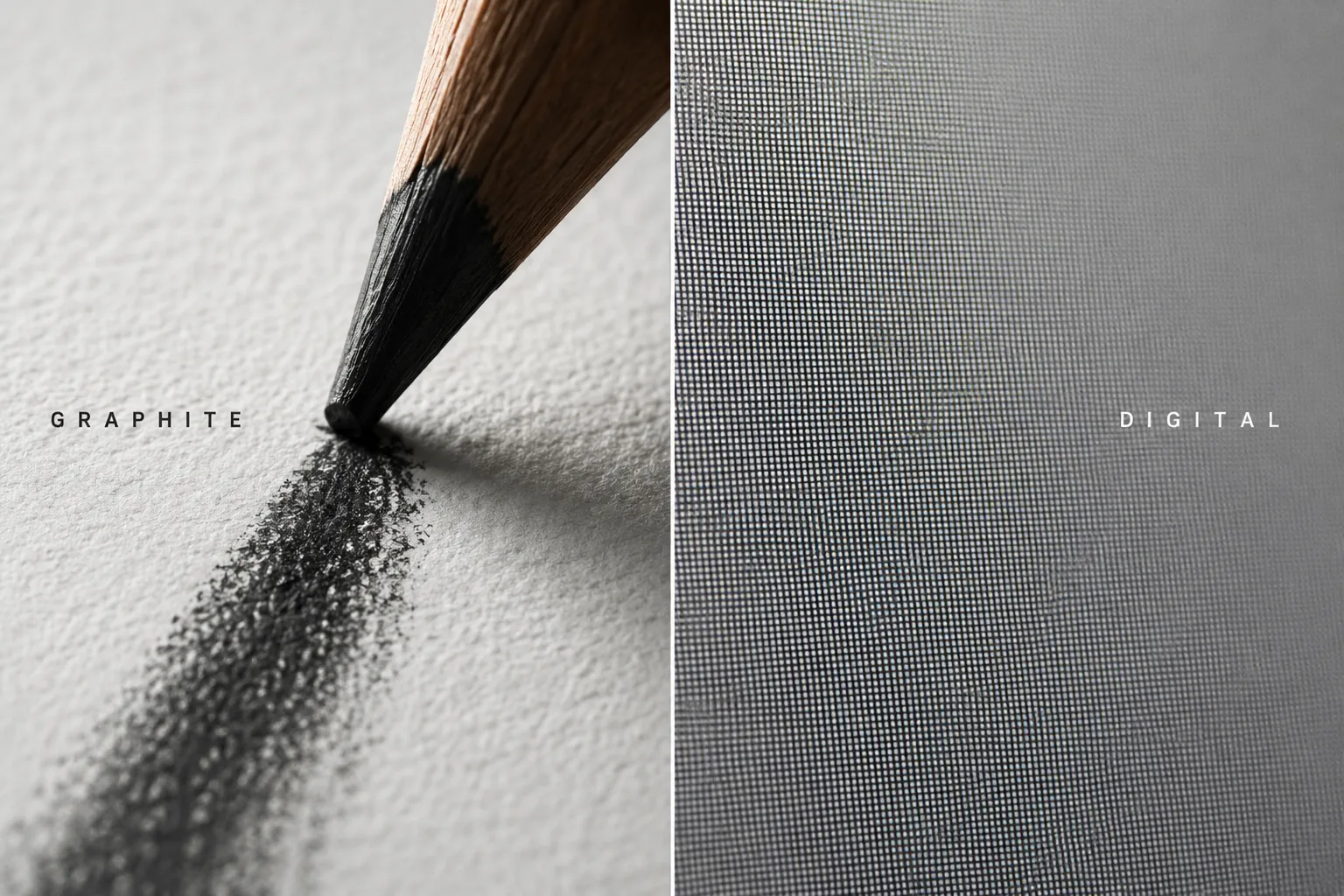
When a graphite pencil is dragged across the surface of paper, microscopic flakes of graphite are sheared off the pencil core. These flakes are not simply deposited on top of the paper. They are physically forced into the microscopic crevices and fibres of the paper surface. The graphite becomes embedded within the very structure of the paper. This is why graphite drawings do not look like they are "floating" on the surface. They appear to be integrated into the substrate. This physical integration is the first major difference in the graphite vs digital art comparison.
This physical integration has profound visual consequences. Because the graphite is embedded in the paper, it reflects light differently than the surrounding white surface. The texture of the paper remains visible beneath the graphite, creating a rich, complex interplay between the medium and the substrate. The paper itself becomes an active participant in the artwork. The tooth of the Bristol board, the direction of the fibres, and the slight imperfections in the paper's surface all contribute to the final image, adding a depth and dimension that no digital screen can truly replicate. This is what makes the graphite vs digital art debate so fascinating.
For a complete toolkit on AI art creation, check out AI for Digital Marketing (50+ Prompts & Workflows) — it includes workflows for creative AI applications like this graphite vs digital art exploration.
Part 1: The Physics and Chemistry of Graphite
To understand why graphite drawing holds such a unique place in the history of art, we must first understand what graphite actually is. Graphite is a naturally occurring crystalline form of carbon. It is composed of layers of carbon atoms arranged in hexagonal lattices. These layers are held together by weak van der Waals forces, which allow the layers to slide over one another when pressure is applied.
When a graphite pencil is dragged across the surface of paper, microscopic flakes of graphite are sheared off the pencil core. These flakes are not simply deposited on top of the paper. They are physically forced into the microscopic crevices and fibres of the paper surface. The graphite becomes embedded within the very structure of the paper. This is why graphite drawings do not look like they are "floating" on the surface. They appear to be integrated into the substrate.
Furthermore, graphite is a layered medium. Each stroke of the pencil adds a new layer of graphite on top of the previous layer. As the artist builds up layers from HB through 2B, 4B, and 6B, the graphite particles stack on top of one another, filling in the paper fibres and gradually increasing the density and darkness of the mark. This layering process creates a rich, multi-dimensional surface that reflects light in complex, unpredictable ways. This is a key point in the graphite vs digital art comparison.
"When you look at a master graphite portrait, you are not looking at a single layer of pigment. You are looking at dozens of overlapping layers of carbon flakes, each reflecting light at a different angle."
Part 2: The Nature of Digital Pixels in the Graphite vs Digital Art Debate
In stark contrast, digital art is composed entirely of pixels. A pixel is a single point of light on a screen. It is not a physical object. It has no mass. It has no thickness. It has no texture. It is simply a combination of red, green, and blue light emitted by a tiny LED or LCD element, which creates the illusion of colour and tone when viewed by the human eye. This is the foundation of the graphite vs digital art divide.
When a generative AI model creates a digital image, it is not creating a physical mark. It is not shearing off microscopic flakes of material and embedding them into a physical surface. It is mathematically calculating the colour and brightness of millions of individual pixels on a grid. These pixels do not interact with a physical substrate. They do not reflect light in the way that graphite reflects light. They emit light. And this difference is fundamental to understanding graphite vs digital art.
The human eye has evolved over millions of years to perceive light reflecting off physical surfaces. We are incredibly sensitive to the subtle variations in texture, sheen, and opacity that characterise physical materials. When we look at a graphite drawing, our eyes are processing the way light scatters off the paper fibres and the embedded carbon flakes. When we look at a digital screen, our eyes are processing the way light is emitted directly from the pixel array. This is why digital art can so often feel "flat" or "soulless" to the human perception — a central observation in the graphite vs digital art discussion.
Part 3: The Tactile Experience — Graphite vs Digital Art
Beyond the physics and chemistry, there is an equally important dimension to graphite drawing that is often overlooked: the tactile experience. Drawing with graphite is a full-body experience. It involves the muscles of the arm, the wrist, the fingers, and the subtle micro-adjustments that the hand makes in response to the resistance of the paper. This is something that AI cannot replicate in the graphite vs digital art comparison.
When a graphite pencil is pressed into the paper, the artist can feel the resistance. The softer the graphite grade, the more smoothly it glides. The harder the graphite, the more scratchy and textured the sensation. The artist adjusts their pressure in real time, responding not to a visual feedback loop, but to a physical one. The hand learns to feel the paper.
This tactile engagement has a profound impact on the visual outcome. The strokes that are produced by a hand that is physically engaged with the paper tend to be organic, varied, and expressive. They carry the signature of the artist's physical presence. The tremble of the hand, the shift in pressure, the slight hesitation as the pencil approaches an edge—all of these micro-movements become part of the drawing. This is what traditional artists understand and what the graphite vs digital art debate often overlooks.
For more on tactile creative experiences, read Practical Photoshop for beginners — it explores the digital side of the graphite vs digital art spectrum.
Part 4: How AI Can Learn from Graphite in the Graphite vs Digital Art Conversation
If we want AI to create truly compelling graphite portraits, it is not enough to simply generate grayscale images that mimic the appearance of a sketch. We must teach the AI to simulate the material properties of graphite. We must encode the principles of physical drawing into the prompt architecture itself. This is the practical answer to the graphite vs digital art challenge.
1. Gradual Layering in Graphite vs Digital Art
Graphite builds depth through repeated layers. A single stroke of 6B graphite is not dark enough to create a deep shadow. The artist must apply the 6B graphite over and over again, layering the strokes until the paper fibres are completely saturated with carbon. This gradual build-up is what gives graphite drawing its richness. AI must be instructed to layer its shading incrementally, rather than applying a single pass of darkness. This is essential for authentic graphite vs digital art simulation.
2. Directional Strokes in Graphite vs Digital Art
Graphite marks have a direction. The direction of the strokes determines the texture of the final image. Hair, eyebrows, eyelashes, and fabric all have specific stroke directions that convey their form and structure. When an artist draws hair, they do not fill in the area with random shading. They draw thousands of individual strokes in the direction of hair growth. AI must be instructed to render directional pencil strokes, not uniform grayscale noise. This is a key distinction in the graphite vs digital art comparison.
3. Paper Texture in Graphite vs Digital Art
The paper itself contributes to the drawing. The tooth of the Bristol board catches the graphite, creating a textured, uneven surface that reflects light in complex ways. AI must be instructed to preserve the appearance of the paper beneath the graphite, rather than covering the entire image in a solid gray overlay. This is what makes the graphite vs digital art gap so significant.
4. Erased Highlights in Graphite vs Digital Art
The kneaded eraser is one of the most powerful tools in the graphite artist's arsenal. Unlike a traditional rubber eraser, a kneaded eraser does not rub the graphite away. It lifts the graphite particles off the paper fibres, revealing the pristine white paper beneath. This subtractive process creates brilliant, natural highlights that cannot be replicated by painting white pixels on top of an image. AI must be instructed to create highlights by removing graphite, not by adding white pixels. This is a fundamental lesson for AI in the graphite vs digital art conversation.
5. Charcoal Accents in Graphite vs Digital Art
In the final stages of a graphite portrait, the artist often reserves soft charcoal for the deepest, richest accents. The pupils, the deep nostril shadows, and the darkest recesses of the hair are rendered with a touch of charcoal. This introduces a subtle warmth and depth that pure graphite cannot achieve. AI must be instructed to reserve soft charcoal only for the deepest accents. This nuanced approach is what separates expert graphite vs digital art from amateur attempts.
Material Properties: Graphite vs Digital Art
| Physical Graphite | Digital Pixels |
|---|---|
| Embedded into paper fibres | Flat points of light on a screen |
| Directional, layered strokes | Uniform grayscale overlay |
| Reflects light organically | No physical reflection |
| Highlights created by erasing | Highlights created by adding white |
| Paper texture visible beneath | No interaction with a substrate |
| Charcoal accents for deep shadows | Uniform colour palette |
Part 5: The Portrait Rendering System as a Bridge in Graphite vs Digital Art
This is exactly what the Portrait Rendering System (PRS) is designed to do. PRS is not just a set of prompts. It is a framework that teaches AI to simulate the physical, material, and tactile properties of graphite drawing. It is the practical solution to the graphite vs digital art challenge.
Every engine in PRS is built to address a specific material property of graphite. The Graphite Construction engine instructs the AI to layer HB, 2B, 4B, and 6B graphite gradually. The Facial Detail engine instructs the AI to use directional pencil strokes for eyebrows and eyelashes. The Museum Finish engine instructs the AI to create highlights through kneaded eraser lifting. The Negative Prompt engine forbids the AI from generating digital textures, photographic pores, or artificial smoothing.
By encoding the material properties of graphite into the prompt architecture, PRS forces the AI to move beyond simple pattern matching and toward genuine material simulation. The result is not a filtered photograph. The result is an authentic, hand-rendered graphite portrait that visibly communicates the physical process of traditional drawing. This is the future of the graphite vs digital art conversation.
"By encoding the material properties of graphite into the prompt architecture, PRS forces AI to move beyond simple pattern matching and toward genuine material simulation."
For the complete PRS system, check out the Portrait Rendering System (PRS) post — it's the full guide to bridging graphite vs digital art with AI.
My Personal Experience with Graphite vs Digital Art
When I started building the Portrait Rendering System, I made a critical mistake. I assumed that if I simply told the AI to "make it look like a pencil drawing," it would understand what I meant. The results were disappointing. The images looked like photographs with a filter applied. They lacked depth, texture, and the organic imperfections that make graphite drawings feel alive.
It took me weeks of experimentation to realise the problem. The AI didn't know what graphite was. It didn't understand that graphite is embedded in paper. It didn't know about directional strokes, layered shading, or kneaded erasers. I had been treating the AI like an artist when it was really just a pattern-matching algorithm.
Hidden hack: The key to teaching AI about graphite vs digital art is to describe the physical process, not just the visual outcome. Tell the AI about the paper texture, the graphite layers, and the eraser lifting. When you encode material properties into your prompts, the AI's output transforms from a digital imitation into a genuine simulation.
Time-saving tip: I use the UBS v1.1 framework to structure all my creative AI content. It saves me hours of planning and ensures every post is optimised for both readers and search engines. For more AI-powered creative strategies, read AI workflow: using AI to generate a 12-post cluster in 48 hours.
Part 6: The Implications for the Future of Art in the Graphite vs Digital Art Era
As we move forward into an era where generative AI becomes more accessible, more powerful, and more deeply integrated into the creative workflows of artists and designers around the world, it is essential that we do not lose sight of the principles of traditional craftsmanship. The goal should not be to replace traditional drawing with AI. The goal should be to use AI as a tool to extend the reach of traditional techniques, to make them more accessible to new generations of artists, and to explore new creative frontiers that were previously impossible. This is the ultimate promise of the graphite vs digital art synthesis.
At Lightson Design Lab, we believe that the future of art is not simply digital, nor is it simply physical. It is a hybrid. It is a fusion of the speed, accessibility, and algorithmic power of AI with the material depth, tactile richness, and human soul of traditional media. The Portrait Rendering System is our first step toward that vision. It is a prototype, a proof of concept, and a declaration of intent. It is our answer to the graphite vs digital art divide.
We are not building a system to replace the human artist. We are building a system that allows the human artist to express themselves through a new medium without sacrificing the depth and craftsmanship that they have spent years mastering.
By understanding the material properties of graphite, the nature of digital pixels, and the role of the human hand in the creative process, we can build AI systems that create art that is truly worthy of the name. We can build systems that do not just imitate art, but that participate in the art-making process itself. This is the mission of the Portrait Rendering System. This is the mission of Lightson Design Lab. And this is the future of the graphite vs digital art conversation.
Ready to Explore Graphite vs Digital Art in Your Own Work?
You now have a deep understanding of the graphite vs digital art debate and how AI can learn from traditional materials. But here's the reality: even with the best insights, creating authentic AI art that bridges this gap takes practice and the right tools.
That's exactly why I built the SEO Content System (UBS v1.1). It's a locked framework that works with ChatGPT, Claude, or Gemini. Define your keyword, audience, and intent once — paste it into the Master Input Sheet — and it generates a perfectly structured outline with H1-H3 hierarchy, ready for your prompts. It includes 12 niche presets, including a Creative Content preset that's perfect for artistic explorations like this graphite vs digital art piece.
This entire guide was built using the UBS v1.1 framework. To see how it works, read the full SEO Content System (UBS v1.1) post on Craftdas.
Final Verdict — Graphite vs Digital Art and the Future of AI
The graphite vs digital art debate is not about choosing one over the other. It's about understanding the unique qualities of each medium and finding ways to combine them. Graphite offers material depth, tactile engagement, and organic imperfection. Digital offers speed, precision, and infinite reproducibility. AI offers pattern recognition, scalability, and new creative possibilities.
By understanding the graphite vs digital art divide, we can build AI systems that create art that is truly worthy of the name — systems that do not just imitate art, but that participate in the art-making process itself.
Your 3 Takeaways on Graphite vs Digital Art:
- Graphite is a physical medium embedded in paper — graphite vs digital art starts with this fundamental difference
- Digital pixels emit light, graphite reflects it — this is the core of the graphite vs digital art gap
- AI can learn to simulate graphite by encoding material properties — bridging graphite vs digital art is possible
Call to Action: Want to explore graphite vs digital art further? Download the free 35-page PRS Toolkit and start building authentic graphite portraits with AI today.
If you found the approach in this post useful, you might also want to read the full Portrait Rendering System guide.
Disclosure: This post contains links to my own products. I only recommend tools I actually use to write my own content.
Comments
There is 1 comment on this article.