
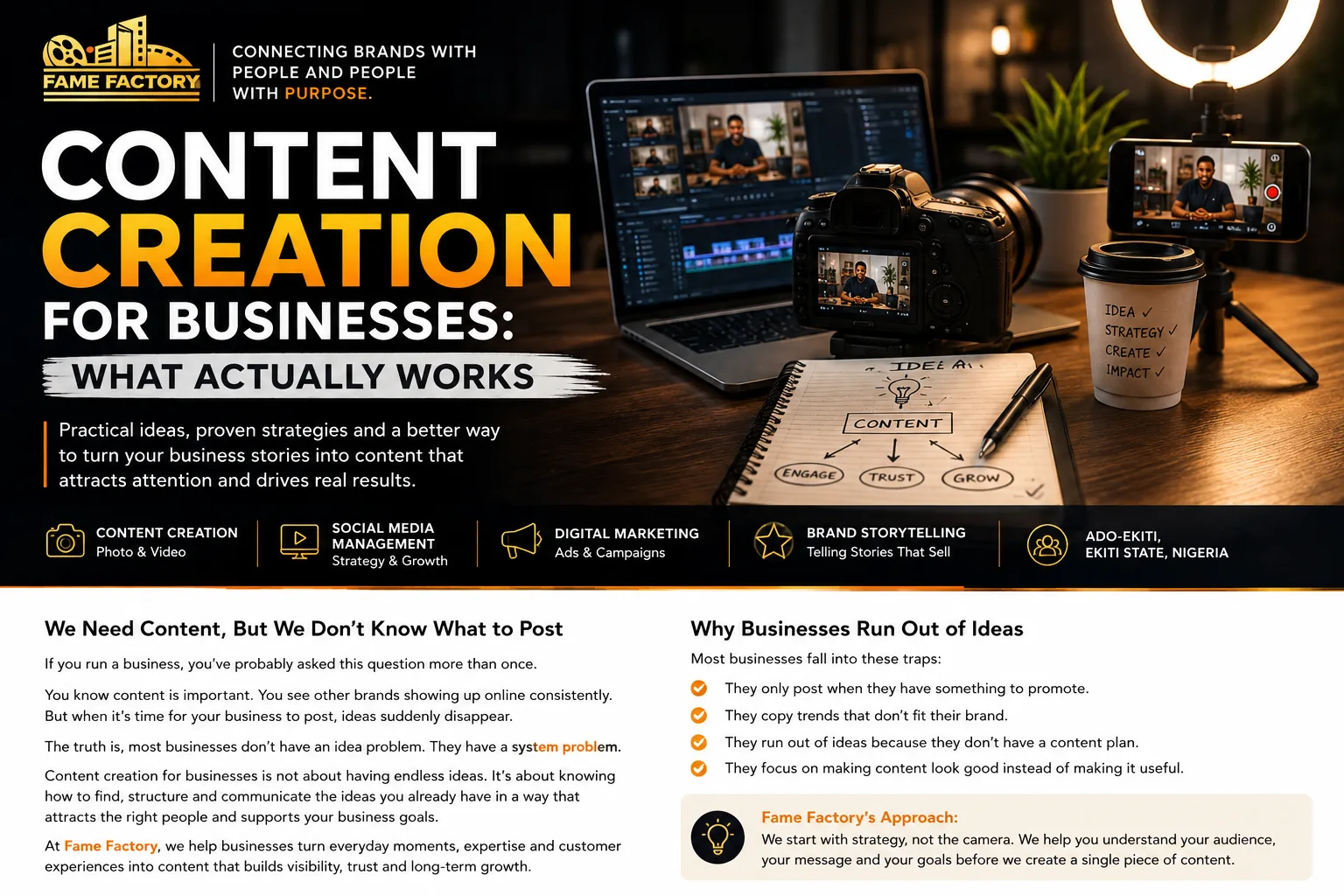

Content Creation for Businesses: What Actually Works
If you run a business, you’ve probably asked yourself this question more than once:
“What are we going to post today?”
You know your business needs to be visible online. You see other brands showing up consistently. You know social media matters.
But when it is finally time to create something for your own business, the ideas suddenly disappear.
And after a while, the cycle becomes predictable.
You post when you have a new product.
You post when there is a promotion.
You post when there is an event.
Then you run out of things to say.
The truth is, most businesses don't have an idea problem.
They have a content system problem.
Content creation for businesses is not about forcing yourself to come up with endless new ideas. It is about learning how to identify, structure and communicate the ideas, experiences and expertise your business already has in a way that people actually care about.
At Fame Factory, this is one of the things we help businesses do: turn what is already happening inside a business into content that builds visibility, trust and stronger connections with the right audience.
Your Business Already Has Content
Let's start with something simple.
Your business is already creating stories every day.
A customer walks into your store and has an interesting experience.
Your team solves a problem for a client.
You receive a question that customers keep asking.
You launch a new product.
You make a mistake and learn something valuable from it.
A customer leaves a great review.
You are preparing for an event.
You change something about your process.
You have knowledge that your customers don't have.
All of these are content opportunities.
The challenge is learning how to recognise them and turn them into something worth watching, reading, sharing or remembering.
Why Businesses Keep Running Out of Content Ideas
There are a few common reasons businesses struggle with content.
They only create content when they want to sell.
If the only time your business communicates online is when you have something to promote, your audience eventually learns that every post is an advertisement.
And people don't want to be advertised to every time they open their phones.
They copy what everyone else is doing.
Trends can be useful, but copying another business without understanding why the content worked for them rarely produces the same result for you.
Your audience, positioning, personality and business objectives are different.
They have no content structure.
When there is no plan, Monday's post depends on Monday's inspiration.
Then Tuesday comes.
Nothing.
Wednesday comes.
Maybe a flyer.
Eventually, the page becomes inconsistent.
This is one of the reasons a business can have good products and still look inactive or uninteresting online.
As we explained in why your Ado-Ekiti business needs more than social media posts, being active online is not the same thing as having a strategy.
Content Creation Is Not Just Making Things Look Good
A beautiful video is not automatically good marketing.
A well-designed flyer is not automatically effective communication.
A professionally edited reel can still fail if nobody understands why they should care.
This is where businesses sometimes get content creation wrong.
They focus so much on production that they forget the message.
At Fame Factory, we believe the camera should come after the idea.
Before creating anything, we need to understand:
- What does the business do?
- Who is the business trying to reach?
- What problem does it solve?
- What does the audience need to know?
- What makes the business different?
- What should people feel, understand or do after seeing the content?
Once those questions are clear, the creative direction becomes much easier.
Content Should Solve a Business Problem
This is probably the most important principle in business content creation.
Don't create content simply because you need something to post.
Create content because there is something your business needs to communicate.
For example, imagine you own a fashion brand.
Your problem may not be awareness. People may already know you exist.
The problem may be that they don't understand why they should buy from you instead of another fashion brand.
Your content can then demonstrate quality, styling, customer experience, craftsmanship, originality or whatever genuinely separates your brand from the competition.
Now imagine you run a restaurant.
Your problem might be that potential customers don't know what makes your food or experience different.
Your content could show the preparation process, customer reactions, signature meals, the atmosphere, your team and the experience people can expect.
Or perhaps you provide professional services.
Your biggest problem may be trust.
People need your service, but they aren't convinced that you are the right person to provide it.
Your content can answer their questions, demonstrate your expertise, explain common problems, show results and introduce the people behind the business.
That is the difference between creating content and simply creating posts.
Five Types of Content Every Business Can Create
1. Educational Content
Teach your audience something useful.
Answer questions your customers ask regularly. Explain complicated things simply. Correct misconceptions. Share knowledge that helps people make better decisions.
When you educate consistently, people begin to associate your business with knowledge and expertise.
2. Demonstration Content
Don't always tell people what your product or service can do.
Show them.
Demonstrate the product.
Show the process.
Take them behind the scenes.
Let potential customers see what the experience actually looks like.
3. Storytelling Content
People connect with stories.
Tell people how your business started.
Introduce the people behind it.
Talk about challenges you've overcome.
Share lessons you've learned.
Tell customer stories.
Your business is not just a logo and a product. There are people, decisions, challenges and experiences behind it.
4. Social Proof
Sometimes the strongest thing you can say about your business is something your customer has already said.
Testimonials, reviews, case studies, customer reactions and user-generated content can help reduce the uncertainty that comes before a purchase.
Instead of repeatedly saying, “We are the best,” show people why customers trust you.
5. Promotional Content
Of course, businesses need to sell.
There is nothing wrong with promoting your products, services, offers or events.
The problem is when every piece of content is trying to make a sale.
Your audience needs more than an offer.
They need reasons to pay attention to you in the first place.
Give them value. Build familiarity. Build trust. Then make the offer when it makes sense.
Stop Creating Content Only When You Have Something to Sell
Think about your own buying behaviour.
Would you trust a business you only heard from whenever they wanted your money?
Probably not.
People need to encounter your brand multiple times before they become comfortable with it.
That doesn't mean bombarding them with content.
It means giving them different reasons to interact with your brand.
Teach them something.
Make them laugh.
Show them your process.
Answer a question.
Share a customer experience.
Tell a story.
Then, when you have something to sell, the audience already knows who you are.
One Business Idea Can Become Many Pieces of Content
You also don't need a completely new idea every day.
One strong idea can become several pieces of content.
Let's say you own a restaurant and want to promote one of your signature meals.
That single product can become:
- A video showing how it is prepared.
- A customer reaction video.
- A photograph of the finished meal.
- A post explaining what makes the meal different.
- A behind-the-scenes video from the kitchen.
- A limited-time offer.
- A question asking customers how they prefer it served.
Same business.
Same product.
Different stories.
This is how businesses can create more content without constantly feeling like they have to invent something completely new.
Content Needs a Strategy Before It Needs a Camera
This is where professional content creation becomes valuable.
A camera can capture an image.
An editor can make a video look polished.
A designer can make a graphic attractive.
But none of those things automatically tells you what should be communicated.
That decision comes first.
At Fame Factory, our approach to content creation starts with understanding the business and its audience.
We look at the message before the medium.
Sometimes that message needs a short-form video.
Sometimes it needs photography.
Sometimes it needs an interview.
Sometimes it needs a simple educational post.
Sometimes the best content is a real moment happening inside the business that simply needs to be captured properly.
The format should serve the idea—not the other way around.
Why You Shouldn't Build Your Content Strategy Around Trends
Trends can be useful.
They can help content reach more people and allow brands to participate in conversations that are already happening.
But a trend is not a strategy.
If a trend doesn't make sense for your business, forcing it into your content can make your brand look like it is trying too hard to be relevant.
The better question is not:
“What is trending?”
Ask:
“Can this trend help us communicate something meaningful about our business?”
If yes, use it.
If not, you don't have to chase it.
Talk to Your Customers, Not at Them
Another common problem is creating content that sounds impressive but doesn't actually speak to the customer.
Businesses use complicated industry language.
They try to sound bigger than they are.
They talk about features instead of benefits.
And the customer is left wondering:
“Okay, but how does this help me?”
Your content should answer that question.
Use language your customers understand.
Talk about problems they actually experience.
Show real examples.
Use real people.
Be clear about what you offer.
Most importantly, sound human.
You don't need to sound like a corporation to look professional.
How to Build a Simple Content System
If your business constantly struggles with what to post, start by creating a few content pillars.
For example:
- Education: What does your audience need to learn?
- Trust: What would make them believe you?
- Story: What makes your business human?
- Proof: What shows that your product or service works?
- Promotion: What do you want people to buy or do?
Now you don't have to wake up every morning and start from zero.
You have a framework.
You can plan different types of content around the same business objectives and maintain variety without losing direction.
How Do You Know If Your Content Is Working?
Views are useful.
But views are not the entire story.
Depending on what your business wants to achieve, you should also pay attention to:
- Comments and meaningful conversations.
- Shares.
- Saves.
- Profile visits.
- Website visits.
- Direct messages.
- Enquiries.
- Bookings.
- Leads.
- Sales.
A video with 5,000 relevant views that generates customers can be more valuable to your business than a video with 100,000 views that produces nothing.
So don't only ask:
“How many people saw it?”
Ask:
“What did it do for the business?”
When Should You Get Professional Help With Content Creation?
You don't necessarily need an agency from day one.
A business owner can absolutely create content themselves, especially when the business is starting out.
But there comes a point where content becomes too important to treat casually.
You may need professional support when:
- You struggle to create content consistently.
- You don't know what your audience wants to see.
- Your content looks disconnected from your brand.
- You have ideas but don't know how to execute them.
- You don't have the time to film and edit properly.
- Your business is growing but your online presence is not keeping up.
- You want your content to contribute more directly to your marketing goals.
That's where a creative marketing team can become more than someone who simply “handles the page.”
How Fame Factory Helps Businesses Turn Ideas Into Content
At Fame Factory, we don't believe businesses need more content for the sake of having more content.
They need content that communicates something.
We start by understanding the business, its audience and its objectives.
Then we look for the stories, products, experiences, knowledge and opportunities that can become meaningful content.
From there, we can develop the creative direction and choose the right format—whether that means photography, video, interviews, social media content, event storytelling or another creative approach.
Our wider work is built around the same idea of helping brands get seen, heard and remembered.
Because content should not simply make your page look busy.
It should help people understand why your business matters.
Your Business Has More Stories Than You Think
If you feel like you've run out of content ideas, take a closer look at your business.
Look at your customers.
Look at your products.
Look at your process.
Look at your team.
Look at the questions people ask you.
Look at the problems you solve every day.
There is probably more there than you realise.
The job of content creation is to find those stories and communicate them in a way that matters to the people you want to reach.
Final Thought
Your business doesn't need to post more just for the sake of being active.
It needs to communicate better.
It needs content that educates, entertains, demonstrates, builds trust and gives people a reason to remember the brand.
And most importantly, that content should connect back to a real business objective.
More content isn't always the answer. Better content is.
At Fame Factory, that's the kind of content we want to help businesses create.
Content that connects brands with people and people with purpose.
Fame Factory
Creative Marketing Agency
Ado-Ekiti, Ekiti State, Nigeria
CONNECTING BRANDS WITH PEOPLE AND PEOPLE WITH PURPOSE.
Ready to turn your business ideas into content people remember? Let's build something.
Comments
No comments yet. Start the conversation.