
What tools do creators need in 2026? The answer isn't a single tool — it's a connected system. Most creators use Canva for design, Shopify for selling, and WordPress for publishing. But these tools don't talk to each other. Your content doesn't connect to your offers. Your proof doesn't support your services. Your audience gets confused. Here's what tools creators actually need — and why Craftdas is the system that brings everything together.
Table of Contents
- The Real Problem Creators Face
- What Tools Do Creators Need — What Canva, Shopify, and WordPress Actually Do
- Canva: Design Only — The Asset Problem
- What Tools Do Creators Need — Shopify: Sell Only — The Store Problem
- WordPress: Publish Only — The Content Problem
- What Tools Do Creators Need — The Duct-Tape Internet
- What Tools Do Creators Need — So What Is Craftdas?
- What Tools Do Creators Need — How Craftdas Is Different
- What Tools Do Creators Need — Who Craftdas Is For
- Does This Mean I Don't Need Other Tools?
- What Tools Do Creators Need — Frequently Asked Questions
What Tools Do Creators Need — The 2026 Creator Toolkit Guide

If you're a creator building a serious online presence, you've probably heard the same advice a hundred times: design your brand on Canva, sell your products on Shopify, start a blog on WordPress, use a link-in-bio tool to connect everything.
And to be fair, those tools are great at what they do. But here's the truth most people don't say out loud: creators don't have a tool problem. Creators have a connection problem.
The real struggle isn't choosing a platform. The real struggle is building a system where everything works together. Your content should support your offers. Your proof should support your services. Your audience should know exactly what to do next. Most tools don't give you that. They give you pieces of a puzzle with no instructions on how to put them together.
I learned this the hard way. In 2017, I started my first blog with no system. I had a website builder, a separate blog, a separate payment tool. Everything was disconnected. I spent more time managing platforms than creating content. In 2018, I lost everything. My phone was stolen. With it went my logins, my drafts, my momentum. I walked away for years. When I came back in 2025, I built differently. I used one connected system. Everything worked together. My content supported my products. My products supported my services. My services supported my growth.
That's exactly why Craftdas exists. Craftdas is not Canva, not Shopify, and not WordPress — because it wasn't built to replace any of them one-for-one. It was built to solve what they don't solve: the creator journey as a connected workflow. In this guide, I'll answer the question what tools do creators need by showing you exactly why individual tools aren't enough — and what to use instead.
If you're new to Craftdas, start with Introduction to Craftdas — it explains why this platform exists.
The Real Problem Creators Face
Ask any creator what tools they use, and you'll get a list longer than their arm. Canva for design. Shopify for selling. WordPress for publishing. Calendly for bookings. Gumroad for payments. Linktree to glue it all together. The list goes on.
Each tool is powerful on its own. But together, they create a mess. Your brand looks different across platforms. Your audience gets confused about where to go. Your content doesn't connect smoothly to your offers. You spend hours switching between tools instead of creating.
This is what tools do creators need done wrong — a collection of disconnected tools that drain momentum.
This is the "duct-tape internet" — a patched-together collection of tools that barely hold together. It's costing you more than you realize. Every hour you spend switching between tools is an hour you're not creating. Every confused visitor is a potential customer you've lost. Every inconsistency in your brand is a hit to your credibility.
So if you're asking what tools do creators need, the honest answer is: you need a system, not a collection of tools. You need one place where everything connects. That's what Craftdas provides.
What Tools Do Creators Need — What Canva, Shopify, and WordPress Actually Do
Let's start with the tools creators are told to use. Canva, Shopify, and WordPress are the three most recommended tools for creators. Each one is powerful at what it does. But each one also has significant blind spots.
Canva helps you design. It's the go-to tool for creating visuals — social posts, thumbnails, brand kits, flyers, and more. It has democratized design for millions of creators who don't have a graphic design background. You can create professional-looking graphics in minutes without any design experience.
Shopify helps you sell. It handles payments, inventory, shipping, and product pages. If you're selling physical products, Shopify is one of the most robust platforms available. You can set up a store, add products, and start selling in a matter of hours.
WordPress helps you publish. It's the most popular content management system in the world, powering over 40% of websites. It's flexible, customizable, and supports virtually any type of content. You can publish blog posts, create pages, and manage your content with relative ease.
Each tool is a specialist. Canva specializes in design. Shopify specializes in selling. WordPress specializes in publishing. But creators don't need specialists. You need a generalist that connects everything.
Because when you use three different specialists, your content is on WordPress, your products are on Shopify, your designs are on Canva. None of them talk to each other. You're left to stitch everything together with random links and duct tape. That's why asking what tools do creators need is the wrong question. The right question is: what system do creators need to bring everything together? Craftdas is that system.
Canva: Design Only — The Asset Problem
Canva helps you create visuals — flyers, social posts, brand kits, thumbnails, and more. It's an excellent design tool that has democratized visual creation for millions of creators. You don't need to be a professional designer to create professional-looking graphics.
But Canva doesn't help you publish content with structure. It gives you visuals, but it doesn't give you a way to organize those visuals into a coherent content strategy. Your designs live in isolation, not in a system. They're beautiful assets that don't connect to anything.
Canva doesn't help you sell your offers directly. You can't add a buy button to your Canva design. You can't connect your visual assets to your payment flow. Your designs stay as designs — they don't become revenue. They're decoration without commerce.
Canva doesn't help you build credibility and proof. It doesn't show your portfolio, your testimonials, or your client results. You have beautiful designs — but no way to prove they've delivered results for anyone. You can show what you've created, but you can't show what it's accomplished.
Canva doesn't help your audience understand what to do next. Your designs are static. They don't guide your audience toward a purchase, a booking, or a connection. They're just images. They don't lead anywhere.
Canva makes assets. It doesn't build a launch system. When creators ask what tools do creators need, they often get "Canva" as an answer. But Canva only solves one piece of the puzzle — the design piece. Everything else is left for you to figure out.
When I started my first blog in 2017, I used Canva for everything. I had beautiful graphics. I had a consistent color palette. I had templates for every occasion. But I had no way to connect those visuals to my business. My designs were scattered across my blog, my social media, and my portfolio. Nothing was connected. Nothing was working together. I had assets — but no system to make them productive.
What Tools Do Creators Need — Shopify: Sell Only — The Store Problem
Shopify is powerful for running an ecommerce store. It handles payments, inventory, shipping, and more. If you're selling physical products, Shopify is hard to beat. It's a complete store solution that takes care of the technical side of selling.
But Shopify doesn't give creators a natural content engine that supports sales. Your content is separate from your products. You can't easily write a blog post and connect it to a product in a seamless way. Your content lives on one platform, your products on another.
Shopify doesn't manage service-based work and bookings in a creator-first way. It's built for products, not services. If you're a freelancer, consultant, or mentor, Shopify isn't designed for you. You can't easily book clients or manage service packages.
Shopify doesn't unify your portfolio, proof, and identity into a clean brand story. Your store is separate from your portfolio. Your reviews are separate from your products. Your identity as a creator is separate from your store presence. It's fragmented.
Shopify doesn't help you grow beyond "store" into "creator brand." It's a store platform, not a brand platform. You can sell products, but you can't build a complete brand presence. You can't tell your story in a cohesive way.
Shopify runs a store. It doesn't run your whole creator business. When creators ask what tools do creators need, Shopify is often recommended for selling. But selling is just one part of the equation. You need more than a store — you need a brand.
I tried Shopify for my digital products in 2018. It was great for accepting payments. But my blog was on WordPress. My portfolio was on another site. My services were listed elsewhere. I had a store — but my audience didn't know how to find it. They didn't know how to connect my content to my products. The disconnect was costing me sales and confusing my audience.
WordPress: Publish Only — The Content Problem
WordPress is a popular publishing system. It's powerful, flexible, and supports millions of websites. It's excellent for blogging and content management. You can publish anything, customize everything, and build virtually any type of site.
But WordPress doesn't guide creators through a clear monetization workflow. It gives you the tools to publish, but it doesn't help you turn that content into revenue. You have to figure out monetization on your own. You have to install plugins, configure settings, and build your own system.
WordPress doesn't remove plugin chaos and setup fatigue. The plugin ecosystem is overwhelming. You need plugins for SEO, for forms, for payments, for design, for everything. Each plugin adds complexity, slows down your site, and creates potential security issues. You spend more time managing plugins than creating content.
WordPress doesn't connect content to offers in a creator-native way. Your blog posts are separate from your products. Your articles don't automatically lead to your services. You have to manually add links and CTAs, and even then, it doesn't feel natural or connected.
WordPress doesn't unify services, products, courses, and proof without rebuilding. When you want to add a new offer, you often need to rebuild parts of your site. You can't easily evolve without significant effort. Each new income stream requires new plugins, new pages, new integrations.
WordPress can publish posts. It doesn't automatically create a creator economy system. When creators ask what tools do creators need, WordPress is often the answer for publishing. But publishing is just one part of the creator journey. You need more than a publishing platform — you need a business system.
In 2017, I built my first blog on WordPress. I loved the flexibility. I could publish anything. But I had no idea how to connect my content to my products. I had no system for monetization. I was publishing great content — but I wasn't making money. My content was valuable, but it wasn't generating revenue because there was no connection between my content and my commerce.
What Tools Do Creators Need — The Duct-Tape Internet
Creators today are forced to operate with a "duct-tape stack." A typical creator stack looks like Canva for designs, Instagram or TikTok for attention, WordPress for blogging, Shopify for selling, Gumroad or Paystack links for payments, Calendly for bookings, Google Drive for deliveries, WhatsApp for client management, and Linktree to connect it all.
At some point, it becomes exhausting. Your brand looks inconsistent across platforms. Customers get confused about where to go. Your content doesn't connect smoothly to your offers. You spend time managing tools instead of creating. You keep rebuilding every time you level up. Each new offer requires a new tool, a new setup, a new learning curve.
I remember spending hours every week just keeping my tools connected. My blog didn't talk to my store. My store didn't talk to my portfolio. My portfolio didn't talk to my services. I was spending more time managing tools than creating content.
This is the duct-tape internet — and it's what Craftdas was built to fix. I realized that my tools weren't the problem. The lack of connection between them was the problem. I needed a system, not more tools.
Craftdas is built to remove the duct tape. Instead of patching together multiple tools, you get one connected system where everything works together. That's the real answer to what tools do creators need — one connected system that eliminates the patchwork and gives you a foundation you can build on.
What Tools Do Creators Need — So What Is Craftdas?
Craftdas is a creator-first platform designed to launch, earn, and grow in one connected system.
Instead of making you stitch together tools, Craftdas focuses on the full creator workflow. It's not another tool to add to your stack. It's the foundation that replaces your stack with a single, integrated system.
The big difference is this: Craftdas isn't "build a website." Craftdas is "build a creator brand." It's a system designed around the creator journey, not around pages and templates. Your website is just the visible layer. Beneath it is a structure that connects everything you do into a coherent whole.
This is what tools creators actually need — a system that supports the entire creator journey, not just one piece of it. Canva gives you design. Shopify gives you selling. WordPress gives you publishing. Craftdas gives you all of them, connected and working together.
What Tools Do Creators Need — How Craftdas Is Different
A single tool solves a single task. Craftdas solves how your tasks relate to each other. Here's how Craftdas is different from the tool stack approach.
What Tools Do Creators Need — Content and Offers Work Together
Instead of content living in one corner and sales living somewhere else, Craftdas is designed so your content can naturally support what you sell. Your blog post can lead into a relevant product, a service offer, a course, a mentorship program, or an affiliate recommendation — not with random links, but with structure.
When your content and offers are disconnected, your audience has to work to find what you're selling. Most won't make that effort. They'll leave. But when your content and offers are connected by design, your audience flows naturally from learning to buying. The friction is removed. The conversion happens organically.
What Tools Do Creators Need — Proof Isn't Optional
Many creators are talented, but struggle to convert because they don't present proof clearly. Craftdas makes proof part of the system: portfolio previews, testimonials, reviews, trust signals, and verification layers where relevant. People don't just buy talent. They buy confidence.
When you present proof alongside your content and offers, you remove doubt. Your audience can see that others have trusted you and gotten results. That trust transfers to them. They become more likely to buy, book, or work with you.
What Tools Do Creators Need — Your Brand Stays Consistent
Creators lose opportunities when their brand looks different everywhere. Craftdas keeps your identity consistent across your profile, your content, your offers, your proof, and your calls-to-action. That consistency makes you look serious — and seriousness converts.
Inconsistent branding is a trust killer. When your audience sees different visuals, different messaging, different experiences across different platforms, they wonder if you're legitimate. Consistency signals professionalism. It signals that you're serious about what you do.
What Tools Do Creators Need — Who Craftdas Is For
Craftdas is built for creators who want to do more than "post." It's built for people who see their work as a career, a business, and a legacy. Here's who Craftdas serves.
What Tools Do Creators Need — Photographers & Videographers
You need more than a gallery. You need a portfolio that sells the experience, not just the images. You need packages and deliverables explained clearly. You need a way to collect inquiries and close clients. You need testimonials that build trust. You need content that helps people discover you.
On Craftdas, your portfolio, your packages, your client proof, and your content can live inside one consistent brand system. Your work doesn't look premium only on Instagram. It looks premium everywhere. Your potential clients can see your work, understand your value, and take the next step without confusion.
What Tools Do Creators Need — Designers & Editors
Editors and designers get referrals, but struggle with consistency. They show their work in scattered posts. Their "pricing" is always in DMs. Clients are unsure how to start. They don't have a system for reviews and proof.
Craftdas turns that into a clean launch: best work, services, process, proof, and a clear path to book. Your design portfolio becomes a client acquisition system. Instead of hoping referrals turn into clients, you have a system that converts visitors into paying customers.
What Tools Do Creators Need — Writers & Bloggers
Writers often have the hardest time monetizing because their content and offers are separated. Your blog posts don't automatically lead to your services. Your articles don't connect to your products.
Craftdas helps creators publish content with a clear growth path. Your content can naturally support digital downloads, affiliate recommendations, services, courses, and mentorship. Your blog becomes a business engine, not just "posts." Every piece of content you publish works toward your business goals.
What Tools Do Creators Need — Instructors & Mentors
Teaching online can become messy fast. Content delivery, enrollment, and earning are disconnected. You're managing multiple platforms to run one mentorship program. Craftdas is built so learning offers can exist as part of your creator brand, not a separate planet you have to manage. Everything connects. Everything flows.
When your courses and mentorship are integrated with your brand, your audience can see the full picture. They can learn from you, then work with you. The transition from student to client is natural, not forced.
Craftdas supports creators who want to build a brand that evolves. That's the real answer to what tools do creators need — a platform that grows with you. Whether you're starting with services, adding products, or building a full ecosystem, Craftdas provides the foundation you need.
Does This Mean I Don't Need Other Tools?
Not exactly.
Craftdas isn't here to insult those tools. It's here to fix the bigger picture. You can still use Canva for your designs. You can still use Shopify for your store. You can still use WordPress for your blog if that's what you prefer.
But Craftdas gives you something those tools don't: one home where your creator business actually makes sense. Instead of being a collection of links, you become a connected brand. Your content supports your offers. Your proof supports your services. Your audience knows exactly what to do next.
Think of it this way: Canva, Shopify, and WordPress are like individual instruments. They can each play a beautiful note. But Craftdas is the conductor who makes all the notes work together to create a symphony. Each instrument is valuable on its own. But together, with a conductor, they create something far more powerful than any single instrument could achieve.
You can still use your favorite tools. But now they have a home. Your content lives in one place. Your offers live in one place. Your proof lives in one place. Your audience can see everything you do, understand what you offer, and know what to do next.
That's the difference between having tools and having a system. Tools solve tasks. Systems solve entire workflows. Craftdas isn't a tool. It's a system. A launch system. A growth system. A creator system. And that's why it's the real answer to what tools do creators need. You don't need more tools. You need a connected system.
What Tools Do Creators Need — Frequently Asked Questions
What tools do creators need in 2026?
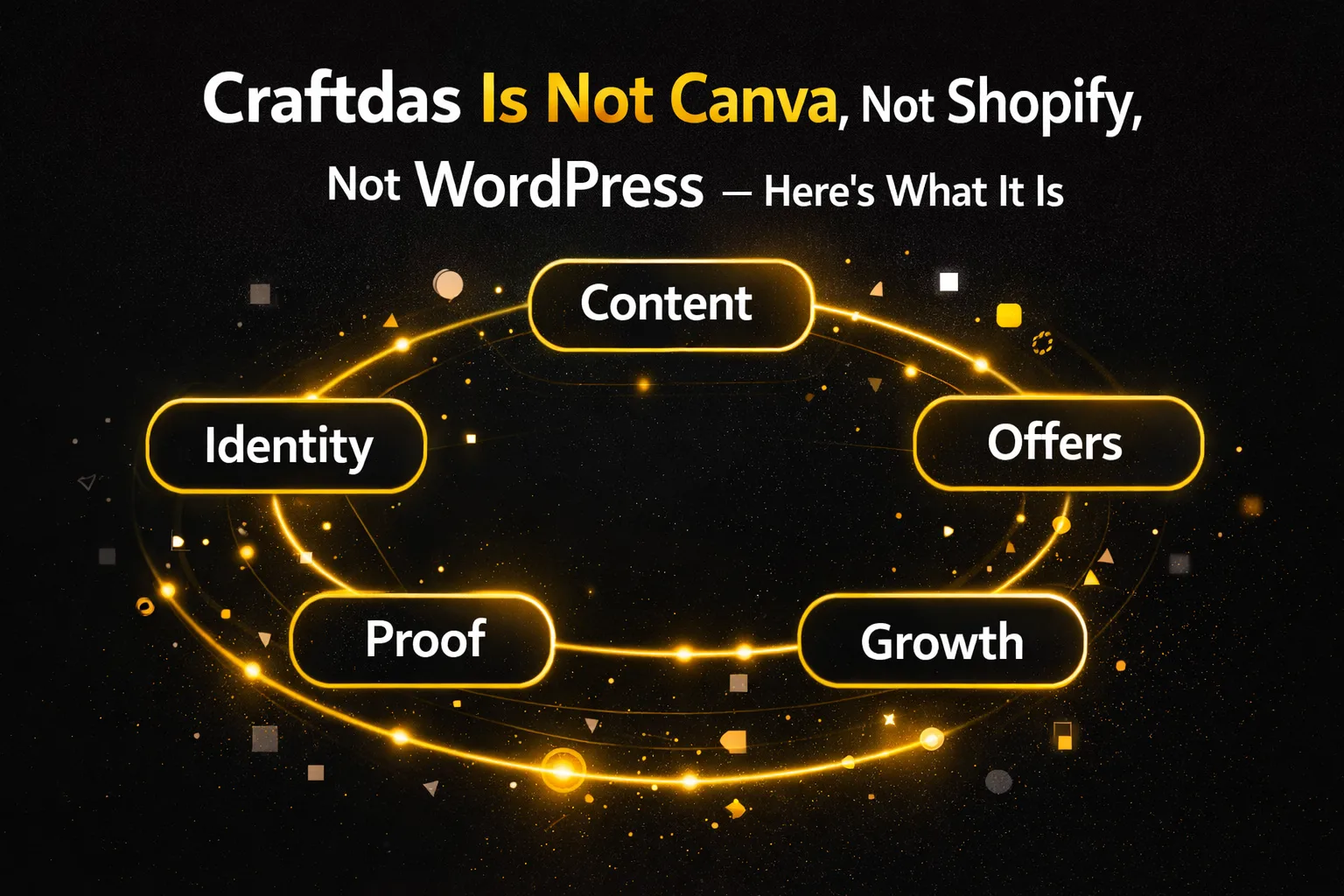
Creators need a connected system, not a collection of tools. The answer to what tools do creators need is a platform that brings together identity, content, offers, proof, and growth in one place. That's what Craftdas provides.
Can I use Canva with Craftdas?
Yes. You can still use Canva for your designs. Craftdas doesn't replace Canva — it complements it by giving you a system to connect your designs to your content, offers, and proof.
Is Craftdas better than WordPress?
Craftdas and WordPress serve different purposes. WordPress is a publishing platform. Craftdas is a creator platform that includes publishing, selling, portfolio, and growth — all in one connected system. If you're asking what tools do creators need, Craftdas gives you more than just publishing.
What makes Craftdas different from Canva, Shopify, and WordPress?
Canva does design. Shopify does selling. WordPress does publishing. Craftdas does all three — plus identity, proof, and growth — in one connected system. It's the answer to what tools do creators need when they want a unified brand, not a collection of tools.
Do I need to rebuild my brand to use Craftdas?
No. Craftdas is designed to help you launch, earn, and grow — not force you to start over. You can bring your existing content, offers, and brand into Craftdas without rebuilding from scratch.
How do I get started with Craftdas?
Getting started with Craftdas is simple. Visit Craftdas to create your account. Then start building your identity, content, offers, and proof. The system guides you through every step.
What Tools Do Creators Need — The Final Verdict
If you're a creator building a serious online presence, you've probably been told to use Canva, Shopify, and WordPress. Each tool is powerful at what it does. But none of them solve the real problem: connection.
Creators don't have a tool problem. They have a connection problem. Your content doesn't connect to your offers. Your proof doesn't support your services. Your audience doesn't know what to do next. Your brand looks different everywhere.
Craftdas solves this. It's a creator-first platform designed to launch, earn, and grow in one connected system. Your identity, content, offers, proof, and growth all live in one place. Everything works together. Your audience knows exactly what to do next. Your brand stays consistent.
Your 3 Takeaways:
- Creators don't need more tools — they need a connected system. Canva, Shopify, and WordPress are individual tools. Craftdas is a connected system.
- Your content should support your offers. Not random links, but structure. Craftdas connects your content to your offers automatically.
- Your brand should be consistent everywhere. Craftdas keeps your identity, content, offers, and proof aligned. Consistency builds trust. Trust builds a brand. Brands win.
Stop fighting disconnected tools. Start building something that lasts. Try Craftdas today.
Call to Action — Build Your Creator Business Today
Ready to take the next step? Welcome to Craftdas — your complete guide to getting started.
For more on building a creator business, read How to Start a Money-Making Blog in the UK.
Want to understand why page builders fail creators? Read Why Page Builders Are Bad for Creators.
For a complete comparison, read Why Craftdas Is Not a Website Builder.
Learn how to launch your creator business with How to Launch a Creator Business.
Related Guides
- Introduction to Craftdas
- Why Craftdas Is Not a Website Builder
- Why Page Builders Are Bad for Creators
- How to Launch a Creator Business
- Welcome to Craftdas
- Can You Make Money Blogging Without a Following?
- How to Start a Money-Making Blog in the UK
Disclosure: This post contains links to my own products. I only recommend tools I actually use to write my own content. For more information, see our privacy policy.
Comments
There are 2 comments on this article.